
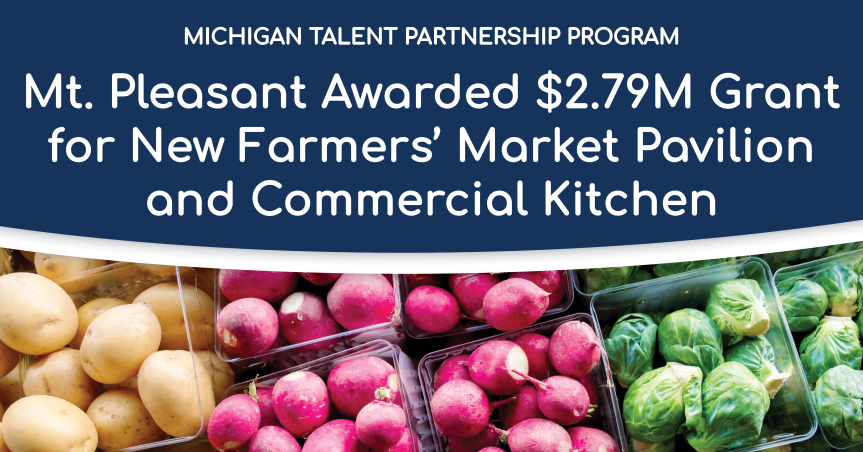
The City of Mt. Pleasant has been awarded $2.79 million through the Michigan Talent Partnership Program, a statewide initiative led by the Michigan Economic Development Corporation (MEDC). The funding will support the construction of a new, multi-use, state-of-the-art pavilion in Island Park, including a commercial kitchen incubator.
The project will be a major addition to the park’s existing pavilions, which were originally constructed in the 1970s. While the current structures have served the City for decades, they cannot provide the flexible, year-round space needed for community programs, gatherings, and events.
“As communities across the state of Michigan continue to navigate uncertain economic times, this grant from the Michigan Talent Partnership Program will allow the City of Mt. Pleasant to build a new and innovative market space that serves as a resource for the entire Mid‑Michigan region,” said Mayor Boomer Wingard.
The new pavilion will feature a redesigned space and an incubator kitchen, creating a versatile venue for residents and community groups. It will support a wide range of activities from farmers’ markets and concerts to festivals, art fairs, and other social and cultural events, offering residents a welcoming, all-season gathering place.
“This investment positions the new multi-use pavilion as a powerful economic driver for Mt. Pleasant, supporting local farmers and vendors while expanding opportunities for small businesses through a commercial kitchen incubator,” said City of Mt. Pleasant Staff. “By creating a year-round destination that attracts visitors, fuels entrepreneurship, and strengthens the local food economy, the pavilion will help grow jobs, increase downtown activity, and enhance Mt. Pleasant’s ability to attract and retain talent.”
The incubator kitchen addresses a critical gap in local and regional food-business infrastructure. Currently, the nearest shared commercial kitchens are located more than 80 miles from Mt. Pleasant, creating a significant barrier for aspiring food entrepreneurs. By offering licensed kitchen space locally, the project will lower barriers to entry, support small and diverse businesses, and help retain food-based enterprises within the community.
With its optimized location and layout, the new pavilion will also strengthen physical and visual connections between Island Park and Downtown Mt. Pleasant, improving walkability, visibility, and the flow of foot traffic between the market and nearby businesses.
Planning and design work for the project is expected to begin in 2026. Additional details will be shared as the project progresses.
More information about the City of Mt. Pleasant Farmers Market is available at www.mt-pleasant.org/farmersmarket.

 City of Mt.Pleasant